Home Home Home
Home Home Home
Search Search
  • SHOP
  • DONATE
  • myGS myGS myGS
  • Find a Council Find a Council Find a Council
  • Español Español Español
  • Search Search
  • Discover Discover

    About Us About Us

    • What Girl Scouts Do What Girl Scouts Do
    • The Family Experience The Family Experience
    • Girl Scout History Girl Scout History
    • Research and Data Research and Data
    • Diversity, Equity, and Inclusion Diversity, Equity, & Inclusion

    Activity Zone Activity Zone

    • Explore Girl Scouts Explore Girl Scouts
    • Grade Levels Grade Levels
    • National Service Projects National Service Projects
    • Virtual Events Calendar Virtual Events Calendar

    Our Stories Our Stories

    • Girl Scout Stories Girl Scout Stories
    • Alum Stories Alum Stories

    Discover Girl Scouts. Learn what Girl Scouts do; about our history, research and data; and about family involvement, or try Girl Scout activities!

  • Get Involved Get Involved

    All About Girl Scouts All About Girl Scouts

    • Join a Troop Join a Troop
    • Find Events Find Events
    • The Benefits of Girl Scouting The Benefits of Girl Scouting

    Volunteer With Us Volunteer With Us

    • Start a Troop Start a Troop

    Alums Alums

    • Beyond Ambassadors Beyond Ambassadors
    • Campus Girl Scouts Campus Girl Scouts
    • Noteworthy Alums Noteworthy Alums

    Learn how to get involved with Girl Scouts. Join a troop, find events, become a volunteer, or discover alum opportunities.

  • Cookies Cookies

    Buy Girl Scout Cookies Buy Girl Scout Cookies

    • Frequently Asked Questions FAQs

    Cookie Flavors & Nutrition Info Cookie Flavors & Nutrition Info

    About Girl Scout Cookies About Girl Scout Cookies

    • Cookie History Cookie History

    Find out how to buy Girl Scout Cookies, explore Girl Scout Cookie flavors, see how girls learn essential life skills, and more.

  • Support Us Support Us

    Donate Donate

    • Individual Giving Individual Giving
    • National Trefoil Society National Trefoil Society
    • Lifetime Membership Lifetime Membership
    • Our Partners Our Partners
    • Planned Giving Planned Giving

    Advocacy Advocacy

    • Girl Scout Advocacy Center Girl Scout Advocacy Center
    • Policy Agenda Policy Agenda
    • Gold Award Recognition Gold Award Recognition
    • Community Champions Community Champions

    Support Girl Scouts by donating nationally or to your local council, becoming a lifetime member, and advocating for girls.

  • Members Members

    For Girl Scouts For Girl Scouts

    • Badges, Journeys, & Awards Badges, Journeys, & Awards
    • Ways to Participate Ways to Participate
    • For Cookie Sellers For Cookie Sellers
    • Uniforms Uniforms
    • Renew Your Membership Renew Your Membership

    For Parents & Families For Parents & Families

    • Raising Awesome Girls Raising Awesome Girls
    • Family Connection Family Connection
    • Cookie Entrepreneur Family Pin Cookie Entrepreneur Family Pin

    For Volunteers For Volunteers

    • Girl Scout Experience Box Girl Scout Experience Box
    • Volunteer Cookie Resources Volunteer Cookie Resources
    • Troop Year Planner Troop Year Planner
    • Tips for Troop Leaders Tips for Troop Leaders
    • Renew Your Membership Renew Your Membership

    Resources for Girl Scout members. Find volunteer, Girl Scout, and family tools and support. Explore badges, activities, and more.

  • SHOP
  • DONATE
  • myGS myGS myGS
  • Find a Council Find a Council Find a Council
  • Español Español Español
  • Search Search

Council Finder

Use this finder to connect with your local Girl Scout council.

By ZIP Code

By State

By Council

close
  1. Members
  2. For Girl Scouts
  3. Badges, Journeys, and Awards
  4. Highest Awards
  5. Highest Awards - FAQ

Highest Awards - FAQ

 Ambassador Girl Scout standing at a railing in front of a lake looking backwards over her right shoulder and smiling.

Find quick answers to your questions about Girl Scouting's Highest Awards : the Girl Scout Gold Award , Silver Award , and Bronze Award .

toggle arrow

There are a few options for kicking off a Highest Award: 

  • Already earned the Bronze Award or Silver Award? They count—each award now leads to the next Highest Award.  
  • Complete one of the new Leadership Awards—and check the prerequisite box. 
  • Complete one Journey to meet the prerequisite (it used to be two for the Gold Award!). Any completed Journey will count, even after Journeys are retired on October 1, 2026. 
toggle arrow

The new menu of Leadership Awards is designed to give Girl Scouts options for how they’d like to build their foundational leadership skills—by leading themselves, others, or their communities. They will choose one Leadership Award that will help them build real-world skills to succeed in their Highest Award and beyond. Leadership Awards count as a prerequisite regardless of when the award is earned.

toggle arrow

Journeys let Girl Scouts experience what they’ll do as they work to earn the highest awards in Girl Scouting. They’ll discover an issue they’re passionate about, connect with experts in their community, and take action to make the world a better place. The skills Girl Scouts gain while working on Journeys help them develop, plan, and implement Take Action projects for their Bronze, Silver, or Gold Award.

Journeys are being retired on October 1, 2026, but Girl Scouts who have already completed the Journey prerequisite or are already working on their Bronze, Silver, or Gold Award can continue uninterrupted.  The Journey prerequisite will never expire. Any completed Journey will count, even after Journeys are retired.

toggle arrow
A Journey is completed when a Girl Scout has earned the Journey awards, which include creating and carrying out a Take Action project.
toggle arrow

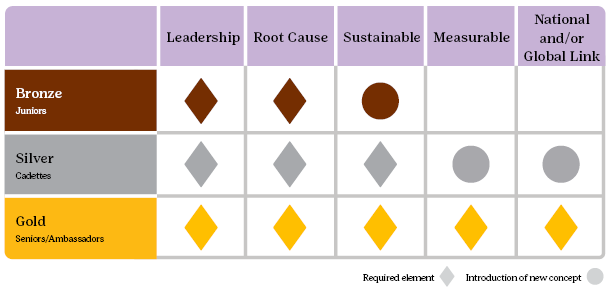
In contrast to Journey Take Action projects, which provide themes on which to base projects, Highest Award Take Action projects have no predesigned theme. A Girl Scout selects their own theme, then designs and executes a Take Action project. Highest Award Take Action projects require the following elements for each award:
Journeys are being retired on October 1, 2026, but Girl Scouts who have already completed the Journey prerequisite or are already working on their Bronze, Silver, or Gold Award can continue uninterrupted.  The Journey prerequisite will never expire. Any completed Journey will count, even after Journeys are retired.

toggle arrow

The time it takes to earn the awards depends on the nature of the project, size of the team, and degree of community support. The quality of projects should be emphasized over the number of hours spent on them. As a guide, the suggested minimum number of hours are:

  • Bronze Award: 20 hours
  • Silver Award: 50 hours
  • Gold Award: 80 hours
toggle arrow

At the Bronze level, Girl Scouts must work together in a team setting. When working toward their Silver Award, they have the option to work individually or in small groups of up to four Cadettes. The Gold Award, the highest award in Girl Scouting, is earned by individual Girl Scouts.

toggle arrow
Yes.
toggle arrow

Yes, Take Action projects for the Bronze, Silver, and Gold Awards may benefit the Girl Scout community. However, there is a specific award progression that should be honored: Take Action projects for the Bronze Award may focus on service in support of the Girl Scout Movement, while Take Action projects for the Silver and Gold Awards are expected to reach into the community to “make the world a better place.” At the Silver and Gold Award levels, a Girl Scout should first consider issues they’re passionate about in the community, school, and world. Then, they should investigate the issue to uncover its root cause, connect with the community to begin developing a solution, and enlist their team. As they develop a project plan, they will determine their target audience. It’s at this step that they might decide Girl Scouts is the best audience or beneficiary.

Overall, award progression offers younger Girl Scouts the opportunity to develop their planning and leadership skills within the comfort and familiarity of Girl Scouting or another local community. As they mature, Cadettes, Seniors, and Ambassadors are ready to move beyond the Girl Scout family to share their leadership skills—and impact—with the wider community. It is in fully exploring their communities that they exemplify the Girl Scout mission.

toggle arrow
Councils and USA Girl Scouts Overseas committees are encouraged to be flexible to serve Girl Scouts’ best interests. If a Girl Scout moves, they should work with the local council or committee to complete the award project.
toggle arrow

Any adult is welcome to use the adult guides, which were designed for volunteers working directly with Girl Scouts earning their awards. Note: for the Silver Award, there is an Adult Guide to Earning the Silver Award. For the Gold Award, there are guides specifically tailored to how parents/caretakers, project advisors, and troop/group leaders can support Girl Scouts in pursuit of the Gold Award.  

toggle arrow
No. Girl Scout Bronze, Silver, and Gold Award work is done to the best of a Girl Scout’s ability. There is no need for special requirements for individuals with disabilities. Accommodations can be made with consideration of any special needs.
toggle arrow

No. The pursuit of the Gold Award is ultimately an individual Girl Scout’s mission. While troop/group members may help, earning the Gold Award requires a Girl Scout to take control of leadership development as they build and lead a team.

toggle arrow
The guidelines offer tools to help examine the underlying root cause of issues, develop sustainable project plans, and measure the impact of Highest Awards projects on their communities, target audiences, and themselves. And yes, there is progression from one grade level to the next. Girl Scout Juniors working toward their Bronze Award will reflect on how their projects could be continued, Girl Scout Cadettes reflect on and put a plan in place for continuation, and Seniors and Ambassadors work to ensure their Gold Award project is sustained beyond their involvement.
toggle arrow

Registered Girl Scout Seniors or Ambassadors.

toggle arrow
Yes. Any Girl Scout who meets the grade-level and membership requirements can earn the Gold Award.
toggle arrow

The best way to make sure Girl Scouts are working at the best of their abilities is to ensure that both they and their adult support system (parent/caregivers, troop/group volunteer, and/or project advisors) receive orientation about the award and understand the difference between community service and a Girl Scout Bronze, Silver, and Gold Award Take Action project. It’s the responsibility of the troop/group volunteer, council staff member, and/or Gold Award committee to work with Girl Scouts to ensure they meet the quality requirements of the award.

Note that Take Action and community service are different—and both are essential to Girl Scouting. When Girl Scouts perform community service, they respond to an immediate need in a one-off, “doing for” capacity; with Take Action, they explore the root causes of a community need and address one in a sustainable way.

Community Service

Take Action

A short-term effort that helps something or someone fulfill an immediate need

A long-term project with sustainable and ongoing influence that addresses an issue's root cause

Joining an existing effort to solve an issue

Creating a unique initiative to address an issue's root cause

Done FOR the community (e.g., collecting blankets for a local animal shelter)

Done WITH the community (e.g. partnering with the animal shelter to create a solution — raising awareness about the importance of spaying/neutering pets; hosting adoption events—to eliminate the need for short-term fixes altogether)

Done as part of an existing team, usually as a volunteer

Creating and leading your own team of volunteers

Working toward a goal that's set by others

Setting the goals and leading a team to achieve them

Ambassador/Senior/Cadette Community Service Bars

Gold, Silver, and Bronze Awards

toggle arrow

A troop/group volunteer is an adult who works with Girl Scouts. Once a Girl Scout identifies an issue, the troop/group volunteer might help them identify a person in the community who could be a great project advisor. 
 
A project advisor is an adult who chooses to be on a Girl Scout’s Gold or Silver Award team, who has some level of expertise of the issue the Girl Scout’s project addresses. A project advisor offers a Girl Scout guidance and expertise as needed, during the planning and execution of the Highest Award project. Note that it’s important that the project and its core ideas be the Girl Scout’s own. 

  • For the Silver Award: Project advisors are optional but recommended. Parents, legal guardians or troop leaders can be advisors. 
  • For the Gold Award: Parents, legal guardians, or troop leaders of Girl Scouts cannot be advisors.  Adult siblings and family members like aunts and uncles can sometimes be advisors if they are experts on the issue the Girl Scout is exploring. However, we encourage Girl Scouts to reach outside their familiar circles and grow their networks when possible. 

It is highly recommended that all project advisors successfully pass a criminal background check performed by the Girl Scout Council or other credible entity, such as the public school system.

toggle arrow

Girl Scouts are encouraged to connect with others in their communities in working toward the Gold Award. That means working with a project advisor who is not their parent/caregiver.

toggle arrow

The project advisor should be identified in the planning phase before the Gold or Silver Award project proposal is turned in to the council. The project advisor expands the network of adults and provides expertise for a project.

toggle arrow
Some councils have developed Girl Scout Gold Award committees to support Girl Scout Seniors and Ambassadors as they go through the process of earning their Gold Award. Gold Award committees are typically made up of community members, educators, key volunteers, and alums who have earned their Gold Award. The committee works with designated council staff.

The committee’s role is to ensure each project meets the national guidelines. Generally, the committee reviews Gold Award project proposals, provides project recommendations and other feedback, reads the final reports, and advises the council on whether to approve projects. At some councils the committee also approves projects. If a Girl Scout’s project has not yet achieved its goals, the committee provides suggestions to help develop a high-quality Gold Award project.
toggle arrow

Sustainability means that the project, as well as the work put toward addressing the issue the Girl Scout has chosen, carries on or continues even after the Girl Scout has done their part and earned their Highest Award.  

  • For the Gold Award: the Girl Scout will put a plan in place that ensures their Gold Award creates lasting change.  
  • For the Silver Award: the Girl Scout will create and put a plan in place to sustain their project; however, how the community partners follow-through is often outside the Girl Scouts’ influence or control.   

Sustainability is not one-size-fits-all. Review three different ways Girl Scouts can ensure their projects are sustainable on pages 6–7 of the Your Guide to Going Gold, and on page 17 of the Cadette Workbook to Earning Your Silver Award.

toggle arrow

A project is measurable when a Girl Scout collects information or data throughout their project and uses it to show that their actions have had a positive impact on the community and/or contributed to addressing their chosen issue. Learn more on page 7 of the Your Guide to Going Gold and page 19 of the Cadette Workbook to Earning Your Silver Award.

toggle arrow

Identifying a national and/or global link doesn’t mean a Girl Scout needs to travel or expand their project across the globe. It’s likely that the issue the Girl Scout has been working toward addressing is relevant worldwide—it can be found in their own local, regional, or national community and across the globe, whether it’s poverty, hunger, illiteracy, homelessness, or pollution.

Girl Scouts should research how other areas, communities, or countries address their issues. Seeing how other people and places implement solutions might inspire their actions and will show them a national or global connection. Girl Scouts can consider reaching out, explain their ideas, and ask for advice, ideas, and even collaboration. Girl Scouts can use what they learn to inform their projects. Plus, these kinds of partnerships can be excellent ways to ensure their project’s sustainability. Learn more on page 5 of the Your Guide to Going Gold and on page 19 of the Cadette Workbook to Earning Your Silver Award.

toggle arrow

Yes, they just need to be a registered Girl Scout in the appropriate program grade level (Senior or Ambassador for Gold Award, Cadette for Silver, Junior for Bronze) to begin working toward their Bronze, Silver, or Gold Award. 

toggle arrow

A Gold Award candidate cannot be both a girl member of Girl Scouts and enrolled in college. A Girl Scout adult, according to Girl Scout guidelines, is either 18 years of age or a high school graduate. To that end, Girl Scouts have until they turn 18 or until the end of their last Girl Scout membership year (September 30 of the year they graduated high school) to complete their Gold Award project.

Note that a Girl Scout who is 19 or older and in 12th grade can continue to be a girl member and earn the Gold Award.

toggle arrow

In this case they would have until September 30 of the year they graduated high school to complete their Gold Award project.

toggle arrow

This is up to the Girl Scout. They might be recognized among their peers for work-in-progress at their council’s Girl Scout award ceremony, be honored in a separate ceremony, or come back for the following year’s ceremony. If the council has a set time for honoring Gold, Silver or Bronze Award Girl Scouts, they should be notified when they begin their project. Girl Scouts and their project advisors are encouraged to work within the council’s timeframe. 

JOIN
VOLUNTEER
DONATE

  • Instagram
  • Twitter
  • LinkedIn
  • Youtube
  • Pinterst
  • Facebook
  • Blogger
  • Contact Us
  • Visit Us
  • Careers
  • Leadership
  • Schools
  • Scholarships
  • Sustainability
  • Financials
  • Faith
  • Terms and Conditions
  • Privacy Policy
  • Frequently Asked Questions
  • Press
  • Blog
  • Manage Email Preferences

Join

Volunteer

Donate

close